
Beyond the Capsule: A Modern, Whole-Person Approach to Frozen Shoulder
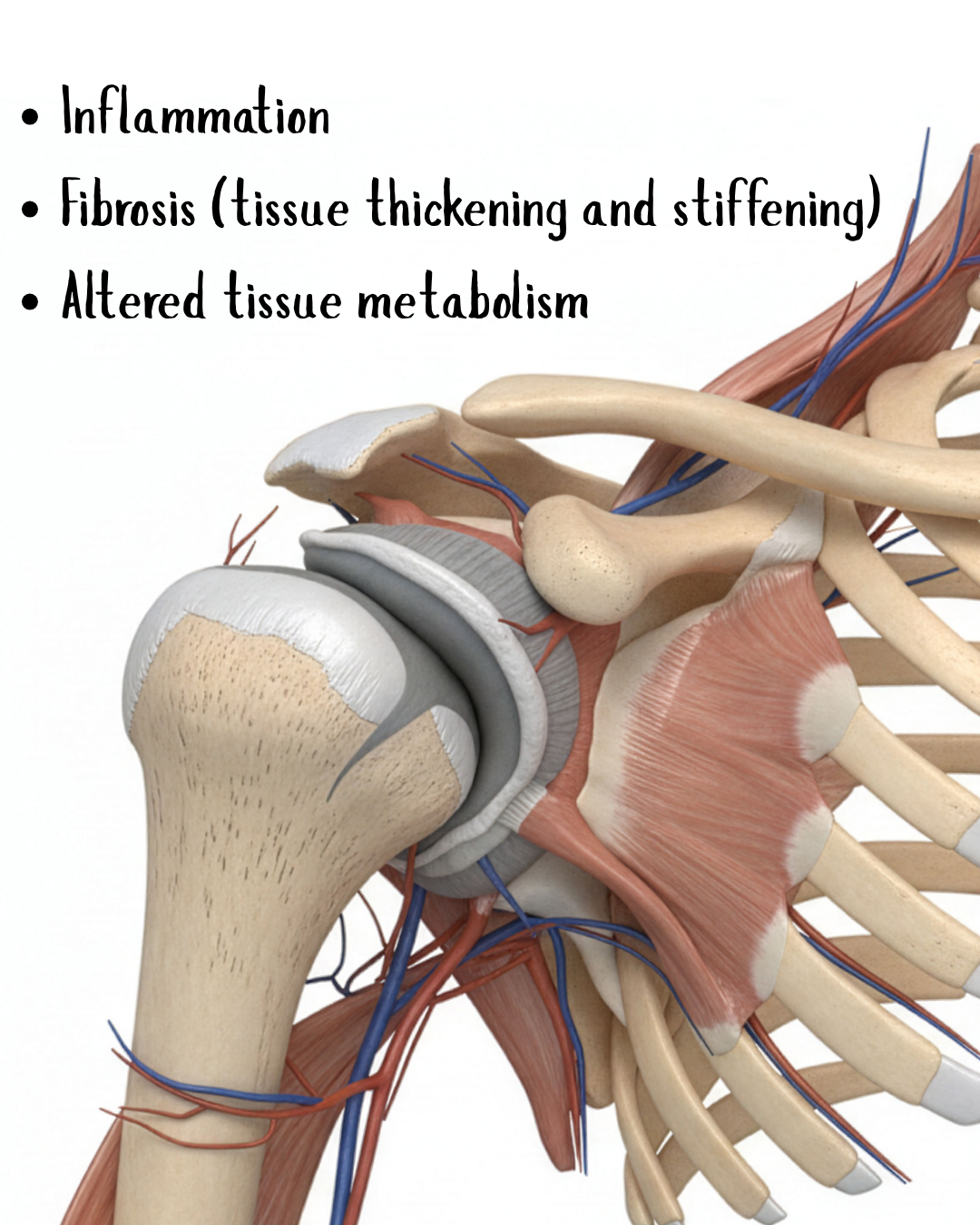
Frozen shoulder—often called adhesive capsulitis—has traditionally been viewed as a problem isolated to the shoulder joint capsule. But emerging research is challenging that narrow view. Today, we understand frozen shoulder as a complex, whole-body condition that reflects more than just a stiff joint—it reflects what’s happening systemically in the body.
At our clinic, this shift matters. Because when you treat the whole person—not just the shoulder—you get better, longer-lasting outcomes.
Rethinking Frozen Shoulder
For years, frozen shoulder was believed to be caused by adhesions within the joint capsule. However, current evidence suggests that true adhesions are not actually present. Instead, the condition involves:
- Inflammation
- Fibrosis (tissue thickening and stiffening)
- Altered tissue metabolism
This means frozen shoulder is less about something being “stuck” and more about how the body is responding to stress, inflammation, and systemic factors.
It’s Not Always “Self-Limiting”
You may have heard that frozen shoulder “just goes away on its own.”
Unfortunately, that’s not the full story.
Research shows that 27–50% of people continue to have pain or limited motion years later if not properly treated.
That’s why early, targeted intervention matters.
What’s Really Happening in the Body?
Frozen shoulder typically progresses through two overlapping phases:
1. Inflammatory Phase
- Increased blood flow and tissue irritation
- Pain, especially at night
- Loss of motion begins
2. Fibrotic Phase
- Tissue thickening and stiffness
- Reduced elasticity
- Significant restriction in movement
At a biochemical level, the body produces inflammatory signals (like cytokines) and substances called advanced glycation end-products (AGEs), which cause collagen to stiffen and lose flexibility.
The Systemic Link: Why It’s Not Just a Shoulder Problem
Frozen shoulder is strongly associated with:
- Diabetes or pre-diabetes
- Thyroid disorders
- Hormonal changes (especially in women 40–65)
- High cholesterol or metabolic dysfunction
- Higher body mass index
- Smoking
- Autoimmune or cardiovascular conditions
In other words, frozen shoulder is often a musculoskeletal reflection of systemic health.
Pain: More Than Just the Joint
Pain in frozen shoulder is driven primarily by:
- Inflammation
- Peripheral nerve sensitivity
However, some individuals may also experience:
- Fatigue
- Sleep disturbances
- Mood changes
This highlights the importance of addressing both physical and nervous system factors in treatment.
How Is Frozen Shoulder Diagnosed?
Diagnosis is primarily clinical and based on movement patterns.
A key hallmark:
- Significant loss of external rotation
- Limited motion in multiple directions
- Often more than a 25–50% reduction compared to the other side
Imaging (MRI or ultrasound) may be used to rule out other conditions, but it is not always necessary.
The Overlooked Piece: The Psychological Impact
Frozen shoulder can be incredibly disruptive.
Many patients experience:
- Sleep deprivation
- Frustration and anxiety
- Loss of independence
- Reduced ability to work or care for others
This “hidden disability” is real—and it must be addressed as part of care.
What Actually Works: A Personalized, Whole-Body Approach
There is no one-size-fits-all solution.
Effective treatment depends on:
- Stage of the condition (irritability level)
- Individual health factors
- Functional goals
At our clinic, treatment may include:
Targeted Physical Therapy
- Activity-based exercises
- Mobility and stretching
- Muscle energy techniques
- Neuromuscular re-education
- Manual therapy (as an adjunct)
Nervous System Support
- Pain modulation strategies
- Graded exposure to movement
Lifestyle Medicine (Essential—not optional)
- Anti-inflammatory nutrition
- Stress management
- Sleep optimization
- Hormonal and metabolic support
Why This Matters
If you only treat the shoulder, you may get temporary relief.
If you address:
- inflammation
- movement patterns
- nervous system regulation
- and overall health
…you create the conditions for true recovery.
The Bottom Line
Frozen shoulder is not just a joint problem—it’s a whole-body condition.
And the best outcomes happen when treatment reflects that reality.
If you’re dealing with persistent shoulder pain, stiffness, or loss of motion, don’t wait for it to “just go away.”
A comprehensive, personalized approach can help you:
- Restore movement
- Reduce pain
- Improve sleep and function
- Get back to your life
References
- Brindisino F, et al. Beyond the capsule: an integrated perspective on frozen shoulder. PubMed ID: 41787861
- Bunker TD. Frozen shoulder: unravelling the enigma. PubMed ID: 7559688
- Neviaser JS. Adhesive capsulitis of the shoulder. PubMed ID: 2069623
- Hand C, et al. Long-term outcomes of frozen shoulder. PubMed ID: 27641499
- Wong CK, et al. Persistent limitations in frozen shoulder. PubMed ID: 30952550
- Cho CH, et al. Pathophysiology of frozen shoulder. PubMed ID: 33205235
- D’Orsi GM, et al. Stages of adhesive capsulitis. PubMed ID: 36075904
- Singh A, et al. Advanced glycation end products in musculoskeletal disease. PubMed ID: 21244749
- Ramirez J. Epidemiology and risk factors of frozen shoulder. PubMed ID: 41156183
- Lewis J. Frozen shoulder contracture syndrome. PubMed ID: 23636125
- Kraal T, et al. Imaging in adhesive capsulitis. PubMed ID: 40042389
- Hanchard NCA, et al. Management of frozen shoulder. PubMed ID: 34487209
- Page MJ, et al. Exercise therapy for frozen shoulder. PubMed ID: 34425089
- Kelley MJ, et al. Activity-based rehabilitation approaches. PubMed ID: 28081633
- Chan HB, et al. Mirror therapy in shoulder pain. PubMed ID: 30056414
- Recent Lifestyle Medicine perspectives in musculoskeletal care. DOI: 10.3390/jcm14207315
Similar Posts


.png)

Insurance Providers
.webp)
.webp)
Cash Based with receipt provided for patient to self submit for out of network benefits for all other insurances
